
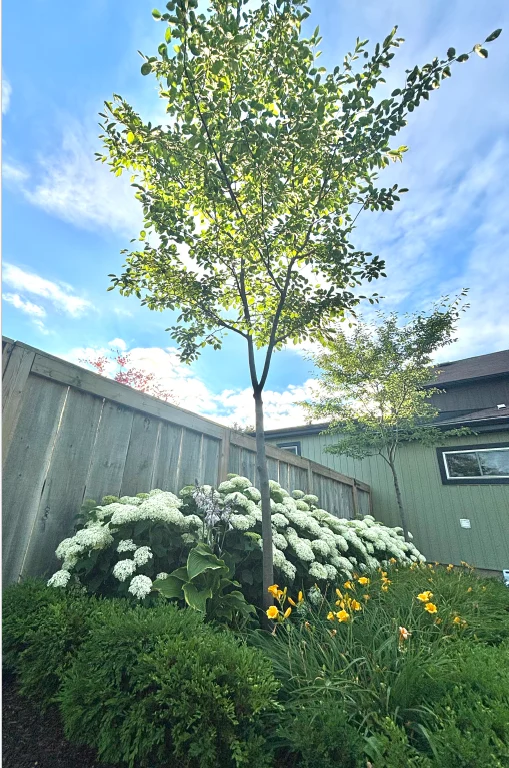
Planting a tree isn’t just about digging a hole and walking away—especially during a hot, dry Ontario summer. Newly planted trees are vulnerable, and the first few years are critical for their survival.
In this post, you’ll learn:
- How long it takes for trees to establish roots
- Watering instructions (with a heat-specific Ontario twist)
- How to care for trees during extended dry spells
- Why quirky, imperfect trees are normal—and valuable
🌱 How Long Does It Take for Trees to Root In?
New trees go through a period of transplant shock, during which they struggle to re-establish their root system. According to the University of Minnesota Extension, most trees take about:
1.5 years per inch of trunk caliper (diameter at planting height)
So:
- A 2-inch tree = ~3 years to establish
- A 4-inch tree = ~6 years to establish
In Ontario conditions, organizations like Maple Leaves Forever agree that most trees need 2–3 years of proper watering and maintenance before they become truly self-sustaining.
💧 Watering Instructions for Newly Planted Trees
Weeks 1–2 After Planting
- Water daily, especially in dry heat.
- Focus on slow, deep watering to saturate the entire root ball.
- Avoid sprinklers—use a soaker hose, drip irrigation, or buckets with holes for even soaking.
Weeks 3–12
- Water every 2–3 days.
- Ensure moisture reaches 12–20 inches deep.
- Monitor the soil—if it’s dry 2–3 inches below the surface, it’s time to water.
Year 1 to 3
- Water once a week, or twice weekly during heatwaves (30°C+ with no rain).
- Focus water at the drip line and just beyond it to encourage root spread.
🌡️ Extra Care for Ontario’s Hot, Dry Weather
- Increase frequency in extended dry periods—young trees have shallow roots and dry out fast.
- Mulch with 3–4 inches of bark or wood chips to conserve moisture, but keep mulch 6–12 cm away from the trunk.
- Water in the early morning or late evening to reduce evaporation.
- Clear grass and weeds around the base to reduce water competition.
- Watch for sunscald on thin-barked trees—wrap trunks or use diluted white paint if needed.
🔄 Trees Come in All Shapes—and That’s Normal
Every tree has its own form. Young trees often appear:
- Crooked or leaning
- Sparse on one side
- “Imperfect” in symmetry
Don’t rush to remove or replace a tree because it looks odd.
🎓 According to arborist research by Gilman & Grabosky (2009), trees naturally adjust their structure over time. Wind, sun exposure, pruning, and root development all influence growth patterns.
With patience and light structural pruning, those quirks typically correct themselves. What looks unbalanced today may become a healthy, unique, and well-formed tree tomorrow.
🌳 Your tree doesn’t need to be perfect—it just needs time.
✅ Quick Reference: Tree Care Schedule
| Phase | Frequency | Method |
|---|---|---|
| Weeks 1–2 | Daily | Deep soak at root ball |
| Weeks 3–12 | Every 2–3 days | Soaker hose or drip line |
| Year 1–3 | Weekly (2× in hot/dry spells) | Deep watering out to drip line |
| Mulching | Always | 3–4″ mulch, kept away from trunk |
| Pruning | As needed (year 2–3+) | Light structural shaping |
🏁 Final Thoughts
Planting a tree is the beginning of a long-term relationship. To help it thrive:
- Be consistent with watering in the first 2–3 years
- Adjust for heat and drought
- Trust the process—trees grow into their shape with time
- Don’t be quick to discard a quirky young tree
The reward? A thriving tree that adds beauty, shade, and value to your landscape for decades.